
Hip Hop History Archive: The Platform as a Living Record

Updated: 5 days ago
Most hip hop history lives in places that were never built to keep it. Songs circulate on mixtapes, street interviews air once on a local channel, and the footage that shows how a block actually looked in a given year often ends up in a box, a hard drive, or nowhere at all. For historians, that gap is the real problem. The hip hop history archive has been assembled piece by piece by people who cared enough to save things, and Hood Box Office is built to keep that work moving. This article explains how researchers, students, and serious fans can treat the platform as a living archive of uncut street culture, and where its material needs careful handling.
Table of Contents
Quick Takeaways
Key Insight | Explanation |
|---|---|
Treat street interviews as first-person testimony | Read them as a speaker's words in a specific place and time, and record the neighborhood and date with every citation. |
Keep uncut versions for language work | Edited broadcast cuts remove pauses and crosstalk, and that is often where the meaning sits. |
Log titles and access dates | Catalog titles rotate over time, so a dated trail keeps your claims checkable after the material changes. |
Pair documentaries with interviews from the same period | The gap between how an event was filmed and how it was later remembered is often the research question itself. |
Search by neighborhood, venue, and crew names for regional scenes | Artist names alone return thin results for smaller markets, so local place names are the more reliable entry point. |
Cross-check with institutional collections | University and cultural collections are stronger for provenance and physical objects than any streaming catalog. |
Why Hip Hop History Needs an Archive
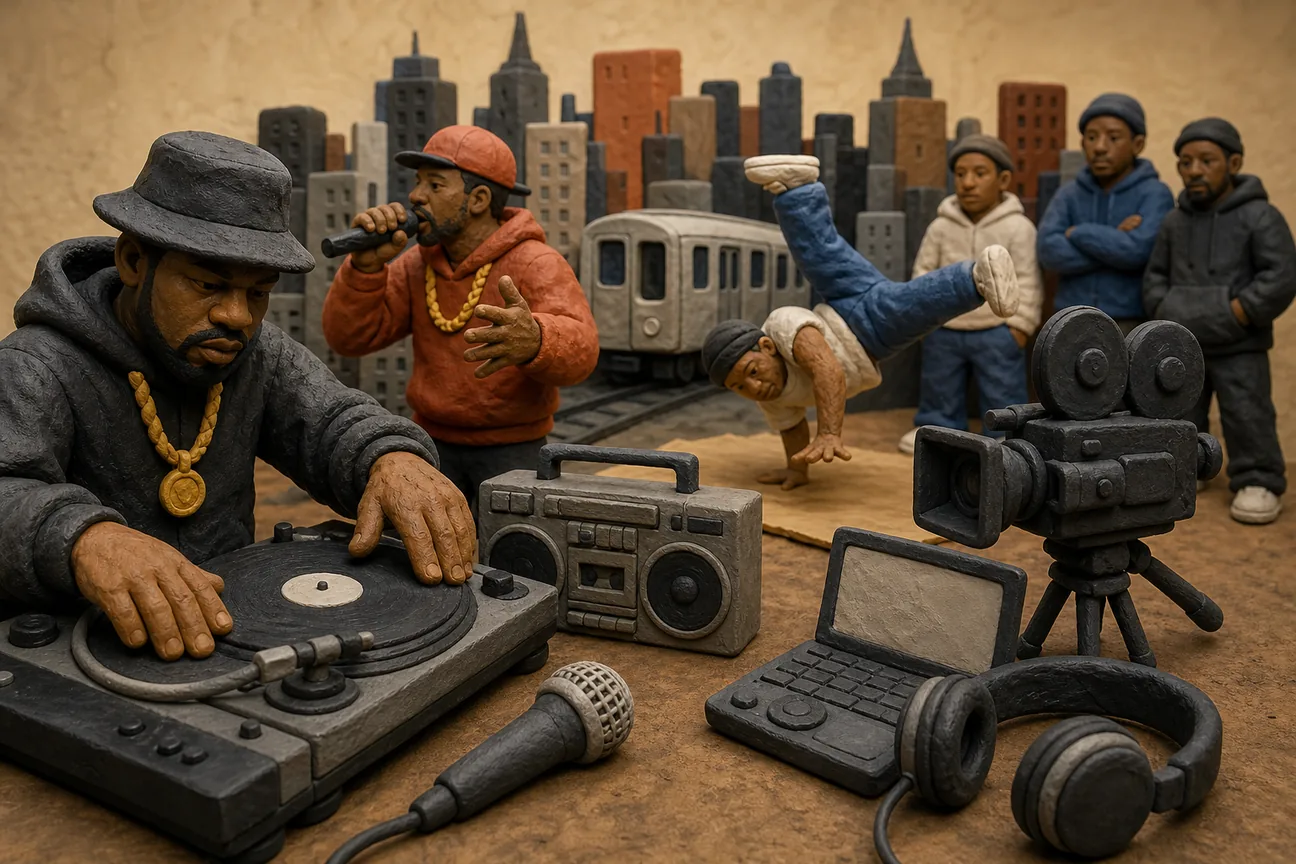
Hip hop's early history was documented mostly by the people making it. The first records of a scene often came from cassette trades, handmade flyers, radio request lines, and home video, not from libraries or museums. That origin is the reason the culture is so rich, and it is also the reason its record is so fragile.

Institutions have started to catch up. The Ohio State University library's subject guide describes hip hop culture and rap music archives as projects that collect, document, preserve, protect, digitize, and share artifacts associated with the culture. That language is useful for a researcher because it names the work. Collection is only one step, and most of the labor happens after the material arrives.
Street culture rarely gets archived on purpose. It gets archived by accident, then rescued by someone who decided it mattered.
That is the gap a living archive is built to fill. A static collection freezes what was saved at one moment. A living archive keeps adding new material, keeps older material accessible, and keeps the context around it current. A historian working today can see how a street interview recorded years ago sits beside a newer documentary about the same block, and that side-by-side view is hard to get from a shelf of disconnected tapes.
Hood Box Office has been streaming this kind of material since 2003, which means the catalog itself carries a timeline. For hip hop historians, the practical questions are simple: what can you actually cite, where does each piece come from, and how do you check it? The rest of this article answers those questions for our catalog, with the caveats we think matter most.
What the Record Actually Holds
Not all archival material does the same job. A narrative documentary is shaped by its director's arc. A street interview is closer to testimony, because the speaker is answering a question in their own words on their own street. A reality series sits somewhere between the two, capturing behavior while the camera is present and then editing it into a story. Historians who treat all three as the same kind of evidence will make avoidable mistakes.
Street Interviews as First-Person Testimony
Street interviews are the most direct material in our library. They record how people talked about police, money, music, church, rivalry, and each other at a specific moment. Because the question was asked on camera, you can usually see what prompted the answer, which is a useful check when you are reading a quote for meaning.
Record the location and date for every interview you cite. A corner in one neighborhood can differ sharply from the next block over, and the same speaker may answer differently in a different season. Treat each clip as a snapshot of a particular place at a particular time, not as a summary of the whole culture.
Documentaries and Reality Formats as Dated Evidence
Hood documentaries, urban reality shows, and hip-hop documentaries each carry a production date and a point of view. Use them to show how a story was told at a particular time, which is often as valuable as the events they describe. A documentary made a decade after the events it covers is evidence of memory and framing, and that is a legitimate object of study in its own right.
In practice, the best use is pairing. Set a documentary beside interviews recorded near the same period and note where the two agree and where they diverge. The divergence is often where the interesting history sits, because it shows how a community's own account changed once the cameras were gone.
Where the Record Breaks Down
A living archive is only as complete as what gets into it. Some of the largest gaps in hip hop history are not missing famous names. They are missing regional scenes, short-lived crews, and artists who never landed a major label deal or a magazine profile. Those people often survive only in the memories of their neighborhoods, and those memories fade.
A Chicago project describing its own mission says it fills gaps in traditional music archives, especially where regional and underground artists have been omitted. That is an accurate diagnosis. Major archives tend to follow the commercial record, and the commercial record is a poor guide to where the culture was actually made and tested.
Regional and Underground Artists
When you search for a scene outside the major coastal centers, expect thin results at first. Many cities had their own sound, their own video makers, and their own street documentarians, and much of that work was never catalogued. If your research concerns a smaller market, search by neighborhood and by the names of local venues and crews rather than by famous artist names alone.
Our catalog gives real weight to street-level footage rather than only to chart history, which is why it can hold material the commercial record leaves out. That does not make every local clip historically complete. It means the clip itself becomes a primary source that a historian can build an argument around, and then test against other records.
Formats That Disappear
Mixtapes, camcorder footage, and early web video were never designed to last. Archivists writing about community hip hop collections have raised the same concern: how to account for, preserve, and maintain items that were produced cheaply and passed from hand to hand. When the original file is lost, the only surviving copy may be the one someone uploaded or broadcast later.
For that reason, a research trail should record not only what you watched but where the copy came from. A version that circulated informally may differ from a version released by the original producer, and that difference matters when you are arguing about dates, credits, or authorship.
How the Platform Works as an Archive
Hood Box Office is a subscription streaming network, and it is worth being precise about what that means for research. Our catalog includes hood documentaries, urban reality shows, street interviews, hip-hop documentaries, and original series made by and for people within street culture. Premium access is $29.99 per month, and that is the figure to check before you plan a semester-long project around the material.

Why Uncut Versions Matter
Broadcast and online edits often remove pauses, crosstalk, and moments a producer decided were off message. Those moments are frequently the most informative part of the record. Our library keeps the uncut, uncensored versions, which means the raw rhythm of a conversation survives, including the hesitations and the arguments that a tighter edit would have cut.
If you are studying language, slang, or the way people negotiated respect on camera, uncut footage is the difference between a usable transcript and a sanitized paraphrase. Transcribe from the full version wherever you can, and flag any spot where you rely on a subtitle or a summary.
Organizing Your Own Research Within a Subscription
Subscription libraries change, and titles can be rotated or removed. Do not assume a segment you found last spring will still be available next fall. Save notes with the title, the episode or segment name, the release date where it is shown, and a timestamp for each key moment. A practical habit is to keep one spreadsheet per project and update it every time you watch.
Keep a separate tab for material you intend to quote. Those entries need the most detail, because they are the ones a reviewer will check first.
Comparing Research Sources
No single source covers the whole history. The three most common options for a hip hop historian are a streaming catalog like ours, a physical or digitized collection held by a university or cultural institution, and the open web, where clips and posts appear and disappear without notice. Each does different work, and the strongest projects use more than one.
Research Source | Strength for Historians | Main Weakness |
|---|---|---|
Hood Box Office subscription catalog | Uncut first-person street material with dated video across several formats | Titles can be rotated or removed, and access requires an active subscription |
University or cultural institution collection | Provenance, physical objects, and archival context that streaming cannot provide | Access often requires an appointment, and holdings reflect what was donated or acquired |
Open web clips and social posts | Fast leads on names, dates, and local scenes | Items disappear without notice, and dates and authorship are often impossible to verify |
The table is a rough guide. A streaming catalog is strongest for first-person street material and dated video. A university collection is strongest for provenance and physical objects, though access usually depends on a specific research question. The open web is fastest for finding leads and weakest for anything you need to cite with confidence.
In practice, start on the open web to find names and approximate dates, check the catalog for the video and interview material, then confirm specifics in institutional collections where they exist. That order keeps you from building an argument on a clip you cannot trace.
Building a Citable Research Trail
Citation is where many street culture projects fall apart. A clip that circulates without a date, a title, or a producer is hard to defend in a footnote. Set a standard before you start, and apply it to every source, including ours.
Logging Titles and Air Dates
For each item, record the title as it appears on the platform, the segment or episode name, the release or production date where it is shown, and the date you accessed it. Access dates matter because catalogs change. Without them, a reader cannot check your claim against the version you actually saw.
Pro tip: Screenshot the title card and the credits for every source you plan to quote, and store the image with your notes. Credits often name the producer, editor, and location, and they can disappear from a version that is later re-edited.
Separating Testimony From Commentary
A street interview gives you a speaker's words. A documentary gives you a director's selection of speakers, edits, and music. Keep those layers apart in your notes. When you write that someone said something, specify whether you heard it in a direct interview, a voiceover, or a reenactment, because a reader will assume the difference unless you state it.
A common mistake is to quote an on-screen caption as if it were the speaker's own statement. Captions are written by producers, and they sometimes compress or correct what was said. Transcribe from the audio whenever you can, and mark any line you could only read on screen.
Pimp Culture Documentaries as Evidence
Pimp culture documentaries occupy an uncomfortable place in the study of hip hop. The subject has been mythologized, sensationalized, and sometimes sold back to audiences as entertainment with little context. Historians still have good reasons to study it, because the stories people told about hustling, fashion, and status reveal how a generation understood money, risk, and reputation.

Reading the Frame
Start by asking who organized the story and why. A documentary built around a single figure will emphasize that figure's account, and it may leave out the people who were harmed by the same scene. Note what the film presents as normal, what it treats as spectacle, and what it never shows at all.
Read the production context before you read the content. Who funded the project, who appears in the credits, and how the title was marketed all shape how the material should be weighed.
Who Speaks, and Who Does Not
Count the voices. In many productions of this kind, the central interviewees are men speaking about their own careers, while women, family members, and rivals appear rarely or only briefly. That imbalance is a finding in itself. Record it in your notes so your analysis does not inherit the producer's frame by default.
Pro tip: Build a simple speaker table for each documentary you study, listing who appears, how often, and in what role. The table takes an hour and often reveals the film's argument faster than a second viewing.
Limits of Streaming as a Source
Streaming is now a mainstream way to watch. A Pew Research Center short read published in July 2025 found that 83% of US adults say they watch streaming TV, which means many readers will recognize the format immediately. That familiarity is useful, but it does not make streaming a stable archive. Platforms license, rotate, and remove titles, and the terms that govern access can change.
Permanence and Access
Do not build a thesis on a single title that you cannot retrieve later. Where possible, pair platform material with a copy held by an institution, a recorded interview, or a published transcript. In your methods section, state how you accessed the material and when, so a reader can judge whether your evidence is still available.
A practical rule: if a key claim depends on one clip, find a second source for it before you submit the work. If you cannot, say so openly in the text.
Verifying What You Cannot Check
Some claims in street documentaries cannot be verified from the film alone. A date, a venue, or a relationship may be asserted without a source. Mark these as unverified in your notes, and do not let them carry the weight of your argument. A narrower sentence that you can support is more useful to a reader than a precise one you cannot.
Frequently Asked Questions
Is Hood Box Office useful for academic hip hop research?
Yes, especially for first-person street material and dated video. Log titles, release dates, and access dates, and cross-check any claim that matters against institutional sources before you rely on it.
How much does access cost?
Premium access is $29.99 per month. Confirm the current terms on the site before you plan a project, since subscription details can change.
Can I cite a street interview from the platform?
Yes. Cite the title, the segment name, the production date if it is shown, the date you accessed it, and the location if the interview states it.
What is the difference between a living archive and a traditional collection?
A traditional collection usually holds what was donated or acquired at a fixed point. A living archive keeps adding material and keeps context current, though it carries the risk that titles can be rotated or removed, so your citations need to be stronger.
Why does uncut footage matter for research?
Edited versions often remove pauses, crosstalk, and moments a producer considered off message. Those cuts can change how a conversation reads, so transcribe from the full version whenever it is available.
Where should I start if my topic is a regional scene?
Start with local venue names, crew names, and neighborhood references rather than artist names alone. Then check institutional collections focused on that region, because local material is more likely to survive there.
Share your experience with the sources you rely on for hip hop research, and tell us which gaps have cost you the most time.
References
Ohio State University subject guide on hip hop culture and rap music archives
Towson University research guide to hip hop exhibits and archives
Chicago Hip Hop History Project on filling gaps in regional music archives
Article on building community hip hop archives and preserving their artifacts
Pew Research Center findings on how many US adults watch streaming TV


Comments